The Boston Globe published a peculiar article the other day on “The top 15 high schools in Massachusetts.” It wasn’t exactly an article, being a slide show of 16 images, each with a bit of associated text. And it was… Read More ›
Math
Finding the beauty in math
In Finding the Beauty in Math, Holly Korbey writes about a recent essay in the New York Times. I would love to be convinced by Korbey’s article and by the essay she cites. I really would. But unfortunately I’m not…. Read More ›

Calculating calories at Jake's
After visiting one of those railroad museums in Connecticut, Barbara and I were looking for a place to have lunch without having to drive around a lot to find a good restaurant. So we spotted Jake’s Wayback Burgers right there in… Read More ›
Trust the math!
Bruce Schneier, America’s foremost expert on cryptography and security, is understandably concerned about the recent revelations concerning the NSA: By subverting the Internet at every level to make it a vast, multi-layered and robust surveillance platform, the NSA has undermined… Read More ›
Tricks? Not here!
My colleague Donna Gonzalez and I have discovered that we often have similar points of view. One pet peeve we have in common is that we sometimes hear students (or even teachers!) talk about “tricks” for solving math problems. Making… Read More ›
Is memorization necessary, evil, both, or neither?
Ben Orlin has written a fine article for the Atlantic called “When Memorization Gets in the Way of Learning: A teacher’s quest to discourage his students from mindlessly reciting information,” along with an accompanying blog post called “Is memorization necessary, evil,… Read More ›
27 new trig functions…and no more factoring
My juniors will be excited to hear that there are now 27 new trig functions for them to learn, and that factoring will no longer be taught. It must be true, since I read it on the Internet. And it’s surely… Read More ›
Cryptography and the NSA
Everyone knows the big splash of news about the NSA revealed by Edward Snowden: “the NSA Is Breaking Most Encryption on the Internet,” in the words of foremost security/cryptography expert Bruce Schneier. This was a matter of great interest here… Read More ›

The Big Ideas of Algebra, Part Three
Four or five years ago, I wrote a couple of posts on the Big Ideas of algebra: Part One was published on November 30, 2008; Part Two on January 7, 2009. It’s time for Part Three, isn’t it? Fortunately, the… Read More ›
“Geometry is the glue between statistics and computer science.”
A provocative quotation: “Geometry is the glue between statistics and computer science.” Say what? Well, that’s what Michael Jordan claims. No, not that Michael Jordan. This one is a computer scientist from UC Berkeley. But what on earth does his… Read More ›
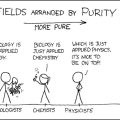
The four pillars of high-school mathematics
What do we teach in high-school math? If we look at the big picture —not at specific topics in specific courses — what do we teach? Numbers? Formulas? Algorithms? Taking standardized tests? All of the above? None of the above? There’s… Read More ›
The case against Algebra II?
The reason these kids are upset is that they are required to do something they can’t do. They are forced, repeatedly, to stare at hairy, square- rooted, polynomialed horseradish clumps of mute symbology that irritate them, that stop them in… Read More ›
How to pick a tutor…or not
Who needs a tutor? You do! Well, no…you probably don’t. Even if you’re faced with the challenge of Honors Geometry (a rude awakening to many students who are suddenly faced with the demands of their first high-school honors math course),… Read More ›

Using web-based technology in math courses
Yesterday we had a one-day workshop on using web-based technology in math courses. The premise was that the technology used in our math courses has been almost unchanged over the past ten years, despite the big improvements in web-based applications that… Read More ›

It’s tough to type math.
Mathematical expressions and equations are normally written on paper with a pencil, or on a blackboard with chalk, or on a whiteboard with markers. There’s a good reason for this: it’s really hard to type math, whether you’re using an… Read More ›

Paul Lockhart
Three and a half years ago I wrote a post about Paul Lockhart’s book, Mathematician’s Lament. Now he has a new book, oddly titled Measurement. Why, you ask, is that title odd? It’s because the book is only peripherally about measurement. Mostly it’s… Read More ›
Graphing lines
So here’s the question: should we teach students that the slope-intercept form of the equation of a line is y = mx + b ? Or should we teach it as y = a + bx ? And does it matter? I contend that it does matter, and that there are several good reasons… Read More ›
AIME revised
Contrary to my post of February 22, it turns out that Weston actually has nine students, not eight, who qualified for the AIME. Pravina Samaratunga (junior) took the qualifying test at a different location and therefore wasn’t included in my original list…. Read More ›
The Joy of x
Steven Strogatz has made a useful contribution to the surprisingly large set of math books written for the general public: The Joy of x: A Guided Tour of Math, from One to Infinity. I have to admit that I started out… Read More ›
The Fractalist
I had expected to be able to leaf through The Fractalist: Memoir of a Scientific Maverick, by Benoit Mandelbrot. I had expected that I would spot a couple of interesting nuggets along the way, but that the story couldn’t possibly sustain my… Read More ›
 Learning Strategies