In HO scale model railroading, tracks always used to have rails that are 0.100 inches high, even though that’s not strictly to scale. Many model railroaders — mostly those who interpret the word “model” strictly — favor the newer versions,… Read More ›
Math
NJ Seeds
I’ve written posts about the Crimson Summer Academy on two earlier occasions: August 20, 2006, and May 23, 2005. Now I’m designing a math curriculum for a program with a somewhat similar basis in New Jersey: the College Prep Program… Read More ›
High-school dropout = criminal?
Last night, Emily Rooney’s Greater Boston included a segment on truancy in the Boston public schools. One of her guests, Suffolk County Sheriff Andrea Cabral, whom I usually admire and respect, claimed that 50% of high-school dropouts (from Boston public… Read More ›
Irrationality
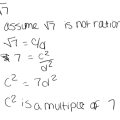
Rudbeckia Hirta reports that her college students have trouble understanding irrational numbers: Most of my students felt that 3 * sqrt(2) / 5 * sqrt(2) was irrational because of the sqrt(2). They didn’t remember that you can “cancel” (hate that… Read More ›
An AP course makes the resume shine
As in a great many other high schools, Weston sees more and more students each year taking Advanced Placement courses. Why is this happening? And is it a good thing? It’s easy to see why it’s happening. Weston students are… Read More ›
Maths
It’s helpful to read what the Brits say about maths teaching. I’ve recently started reading Mathematics in School, a journal published by the Mathematical Association (MA), which is more or less the British equivalent of our National Council of Teachers… Read More ›
Fractal dimension retraction or converse error?
As Ivars Peterson and others have pointed out, Jackson Pollock’s paintings can be analyzed mathematically as fractals, and they turn out to have a distinctive fractal dimension. As various articles have pointed out, inauthentic (forged) Pollocks have incorrect fractal dimensions…. Read More ›
Happy numbers, unhappy families
One of my students came across the Wikipedia article on Happy Numbers and asked about it in precalculus class. This is the sort of topic for which Wikipedia is an excellent source; in fact, if I wanted to know about… Read More ›
7+2=10
I just came across this clipping I had saved from the Boston Globe some years ago. Unfortunately, I don’t know the date, and it’s not really worth the trouble researching it. It quotes Joe Cazazza. who has finally retired from… Read More ›
A Madman Dreams of Turing Machines
Too often the books I review are mysteries (or novels in related genres, such as psychological thrillers). But not this time (and not next time either). Today we’re talking about a straight, mainstream novel — more or less. As you… Read More ›
Hey, Verizon, $.02 does not equal .02¢
You have to listen to this actual mind-boggling conversation between a Verizon Customer Service manager and a Verizon customer. Here is the first astonishing excerpt: Customer: Do you recognize that there’s a difference between point zero zero two dollars and… Read More ›
An obligation to vote?
Everyone knows about the 2004 decision of the Massachusetts supreme court legalizing gay marriage, and everyone knows that laws banning gay marriage have been passed in many states and are in the pipeline in others, but out-of-staters may not be… Read More ›
Poincaré
On NPR’s All Things Considered tonight, there was actually a report about a math problem! To quote science correspondent David Kestenbaum’s report on the Poincaré Conjecture: The journal Science’s “breakthrough of the year” for 2006 is the solution of a… Read More ›
Balance or integration?
In many school districts, including Weston, we try to resolve the Math Wars by promoting a balance between skills and concepts. We tend to adopt the party line as promoted by former Education Secretary Richard Riley: We are suffering here… Read More ›
Misoverestimating minority populations
It worries me that people so consistently overestimate the populations of all minority groups. We know that estimation is difficult, but the magnitude of the errors that I see has genuine political implications for us as citizens. This isn’t just… Read More ›
Connecting math with other disciplines
From time to time we try to connect our math teaching with other disciplines. Often this happens naturally — physics examples in precalculus, biology examples in Algebra II, etc. It’s no coincidence that both of these other disciplines are scientific… Read More ›
The Rule of Four
I recently read The Rule of Four, a truly fascinating novel co-written by first-time authors Ian Caldwell and Dustin Thomason. Fascinating to me, at any rate — your mileage may vary. If you’re interested in Latin, linguistics, typography, academic mysteries,… Read More ›
Using math in the so-called real world?
So what do we say when we hear that all-too-familar question, “When am I ever going to use this in the real world?” [Grammatical footnote: logically speaking, that sentence should have two question marks at the end, one before and… Read More ›
Case of Lies
Catching up on posts about recent reading: I highly recommend Case of Lies, by Perri O’Shaughnessy, especially if you are interested in math or linguistics. If you’re not, it’s still a solid mystery, well above average for the genre even… Read More ›
Sig figs
Science teachers — and science textbooks — generally insist on careful attention to significant figures. Math teachers — and math textbooks — generally pay no attention to them. Here are two representative examples: Our Algebra II textbook contains a word… Read More ›
 Learning Strategies