This note, written by a junior, was attached to the precalculus book she was returning: Dear Mr. Davidson, Here is my book. I have enjoyed it thoroughly. I read it when I was feeling down, and it raised my spirits…. Read More ›
Math
Distribution of U.S. incomes
Check out this interesting visual representation of U.S. income distribution. Try zooming out and out and out…
Fermat's Last Theorem limericks
Weston High School held a math haiku contest, but maybe we should have had a math limerick contest instead. Here are some math limericks about the proof of Fermat’s last theorem (from a contest held at the University of Illinois… Read More ›
Cantor's proofs
A lot of my precalculus students today didn’t like and/or didn’t believe Cantor’s proofs of the denumerability of the rationals and the non-denumerability of the reals. A few articulated their disbelief; most were quiet and attentive, but how many of… Read More ›
Stunning graphs of equations
You have got to go look at the Visual Dictionary of Famous Plane Curves and study some of the stunning images that Xah Lee has collected. I particularly recommend his collection of sinusoids and his gallery of graphics based on… Read More ›

Beware the Algebrator
Yes, there really is a product called The Algebrator. Their slogan is, “You Type in Your Homework Problem. Algebrator does the Rest!” Here is an excerpt from one of their ads. What’s wrong with this picture?
Amusing calculus book?
The pseudonymous Rudbeckia Hirta writes about “the most amusing book ever written about calculus”: The Historical Development of the Calculus, by C.H. Edwards. I know, you don’t think the competition for most amusing calculus book is very stiff, but I’m… Read More ›
Numb3rs
Please read Graham Cormode’s review of the TV show, “Numb3rs” (which he claims is pronounced “Numbthreers” rather than “Numbers”). Brief excerpt: Given low initial expectations, it was probably one of the better attempts to show mathematical topics within the context… Read More ›
Literature & math: imaginary gardens with real toads
This week’s New York Times Book Review contains a fascinating Literary Map of Manhattan, preceded by an explanatory article written by Ethicist Randy Cohen. Quoting Meg Wolitzer, Cohen defines his (their?) “cartographic motto”: a strong sense of specificity, even though… Read More ›
What math has taught him
Sam Hughes is the author of the Venn Diagram cited in my previous post. I also recommend his list of “Things mathematics has taught me”: That there are such things as unanswerable questions — indeed, provably unanswerable questions That Occam’s… Read More ›
Don’t confuse England with Britain
Perhaps a Venn Diagram would help.
Statistics for kids
Do check out the NCES Students’ Classroom site. Good stuff — even though a lot of it is in Comic Sans (see yesterday’s post).
An argument from continuity
Two sophomores approached my colleague Josh with a question: “How can we construct a fair 5-sided die?” Josh posed a prior question: Is it even possible to construct such a die? He fashioned an interesting argument from continuity: Consider two… Read More ›
The view from college math
Rudbeckia Hirta (a clever pseudonym for a math professor who carefully keeps her true identity hidden) observes: Due to reasons beyond my understanding, high school math and college math are completely unaligned. The K-12 system sends us students whose knowledge… Read More ›
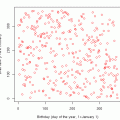
Where visuals fail
Some of us couldn’t possibly forget the 1969 draft lottery, the new and supposedly “fair” system to pick who was going to be sent to Vietnam. My Algebra 2 class is studying probability and was remarkably interested in learning about… Read More ›
High-school math in the 21st century?
What math applications are taught in high school? Principally parabolic arches and widget-manufacturing, of course. This is a bit of an exaggeration, but the principle holds. We teach applications like those rather than cryptography and models of voting. At the… Read More ›
Martin Gardner for pennies
The Mathematical Association of America is selling a CD containing 15 Martin Gardner books (the entire collection of his Scientific American columns) for a mere $55.95 — or $44.95 if you’re a member!
Math license plates
Winners and other entries in the Math License Plate contest.
Risks and probabilities
We know that both adults and kids are notoriously bad at estimating probabilities. Bruce Schneier (one of the world’s leading experts on security, cryptography, etc.) has this to say concerning risks and probabilities: One of the things I routinely tell… Read More ›
 Learning Strategies