Is there such a thing as the Hebrew alphabet? How about the Japanese alphabet? Or the Hindi? “Of course,” you reply. “At least I know there’s a Hebrew alphabet. It has letters like מ, which means ‘m,’ and it’s written… Read More ›
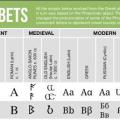
Is there such a thing as the Hebrew alphabet? How about the Japanese alphabet? Or the Hindi? “Of course,” you reply. “At least I know there’s a Hebrew alphabet. It has letters like מ, which means ‘m,’ and it’s written… Read More ›

I just wish this book had been published 20 years ago! Alex Bellos has compiled an amazing collection of language-related puzzles in the Language Lover’s Puzzle Book, released a few month ago in the UK and more recently elsewhere in the English-speaking… Read More ›
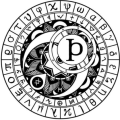
For some obscure reason (I don’t really understand why) I’ve just never been into D&D or any other role-playing games. And yet… …and yet I keep running into various aspects of RPGs (role-playing games) that definitely interest me. Unsurprisingly these… Read More ›

It was 1968. Fully automated translation was just around the corner. Or so I learned in a computer science class. Of course there was officially no such discipline at the time, so it was actually an applied math class, but… Read More ›
Take a word that’s written in one alphabet (Cyrillic, say). Now spell it in another alphabet (Roman, say). Why? Well, Russian is written in Cyrillic, but it’s often necessary to write Russian words in English, using the familiar Roman alphabet…. Read More ›

No, I’m not talking about the notorious difficulties of English spelling. Nor am I talking about the oddities of English idioms and compound words, such as the all-too-well-known “Why do we drive on a parkway and park in a driveway?”… Read More ›
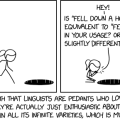
Mouse-over text: “Do you feel like the answer depends on whether you’re currently in the hole, versus when you refer to the events later after you get out? Assuming you get out.”

No, the “sch” in bruschetta is not pronounced like the English “sh”! It’s pronounced like the English “sk.” Bruschetta is an Italian word, not a German word, so don’t pronounce it as in Schadenfreude, to quote James Harbeck in the link below. Actually, the issue is slightly more… Read More ›
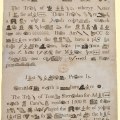
How much of this advertisement (from 1807!) can you figure out? Note that it says “hieroglyphical” where we would have said “rebus” when I was a kid or “emojis” today. You’ll probably do much better at reading it than I… Read More ›
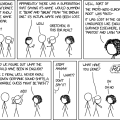
True names are important: if somebody knows your true name, they have power over you. I’m not talking about Vernor Vinge’s important novella, True Names, although there is definitely a strong connection with it. Many contributors to social media, as we know,… Read More ›
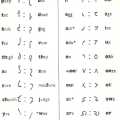
I’ve heard that there are some people who think that English spelling is difficult. In fact, I think I know a couple of them. But nobody has to spend years learning how to spell Spanish words, so why do we… Read More ›
No, I’m not talking about Tom Lehrer’s famous song, “The Elements,” nor about n–2 others of the n parodies of Gilbert & Sullivan’s Major General’s song, where n must be a large number. I’m talking about “I Am the very Model of a Biblical… Read More ›
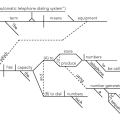
Who remembers diagramming sentences? I do, I do! If you’re my age, you never forget the experience of diagramming sentences. Love it or hate it (I was one of the few who loved it), you don’t forget it. Maybe you forget… Read More ›

That headline isn’t very helpful, as you have no doubt figured out. After all, it’s spelled “GIF,” but it’s pronounced with a hard G as in “gift” — or perhaps with a soft G as in “giraffe.” But which? You probably know the answer…… Read More ›

Hmmm… how can you communicate with someone when the two of you have no language in common? In linguistics this has been a major conundrum, especially in earlier centuries when there was no worldwide communication; in science fiction it has… Read More ›

The philosophers in the program were kind and excellent teachers, but the math professors I met in those days were somewhat less skilled at teaching or relating to people. One told us that we should think of him as a… Read More ›

Why is a lion a typical translator’s pet? That’s surely your first question on looking at the image that accompanies a post titled Koran dankon, tradukistoj, by the great Gaston Dorren, who posts all too infrequently. (In case that sentence is… Read More ›

Tim Cook, Richard Branson, Benjamin Franklin, Rachel Ray, Napoleon Bonaparte, Ernest Hemingway, and Michelle Obama: what do these seven people have in common? Or is it too early in the morning for you? The answer to the first question, according to… Read More ›

The Scots language has been in the news! Until a few years ago I didn’t even know what Scots is. Do you? If you’ve read my post of August 15, you do. Otherwise there’s a good chance that you don’t know, or… Read More ›

“What a silly question!” you reply. “We translate sentences in high-school language classes all the time!” Do you? You might not do that at all (perhaps you took a total immersion class) but let that pass. You probably did at… Read More ›

