Paul Graham has some advice for us: Here’s a simple trick for getting more people to read what you write: write in spoken language. That’s definitely not what your typical English teacher tells us. Writing and speaking are distinct and… Read More ›
Teaching & Learning
Communicating with students
Sam Shah, math teacher extraordinaire from Brooklyn, has recently written a useful post about getting information from students. Like many of us, he begins the year by asking his students to write something about themselves. In my own classes this… Read More ›
We’ve discussed this before, but…
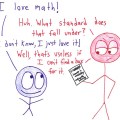
…I can’t resist returning to the topic. You know what I mean. Please read the entire post in today’s Math with Bad Drawings. It won’t take you long. Then, as an exercise for the reader, think about two of the drawings in… Read More ›
Cut scores: What are they, and why do we care?
“Cut scores”? That certainly sounds like esoteric jargon, doesn’t it? But it turns out to be an important concept, even if the general public doesn’t know the phrase. Whenever we scale a test to convert raw scores to scaled scores, we… Read More ›
Accents come from _______
One of the many things that math teachers and linguists have in common is that we are usually misunderstood by the general public. The great David Crystal has written an excellent piece on this subject in the context of being interviewed for an… Read More ›
Extreme photojournalism
Famed New York Times/freelance photojournalist Lynsey Addario gave an intense presentation to students and faculty of Weston High School yesterday afternoon. “Intense” is definitely the word. Never before have I heard eight hundred high-school students sit so quietly and attentively for… Read More ›
How do you organize a binder?
Let’s suppose you have to keep a physical notebook (or binder) for a course you’re taking (or teaching, for that matter). Most people seem to prefer using tabs to give themselves the illusion of organization (oops — that shows my… Read More ›
“I can’t do math!”
In its essence this is a familiar story, but it bears reexamination. We’ll end with the Indian girl who gave up on math at age 15, but we start with the observation that American and Indian kids alike classify themselves… Read More ›
Yay! (maybe)
Good news and bad news here. The good news is that the Obama Administration seems to have softened its stand on mandatory standardized testing, which has resulted in vastly excessive time spent in many schools and totally inappropriate teacher evaluation… Read More ›
JEB @PA
They tell us that students should get to know their teachers. So, every year I show my classes excerpts from Kevin Rafferty’s movie, Regular Guys. This is partly so that my students can get a better picture of my own high-school experience and partly… Read More ›
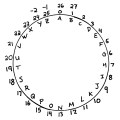
Why crypto in high school?
So I was out to dinner this evening with some old friends — no, not “old” friends in that sense, but “old friends” if you know what I mean — and one of them was surprised that cryptography is effectively… Read More ›

Hello Ruby
Can young kids really learn about coding (which we used to call “programming”)? If so, do they need a computer, or can they learn it better through reading and playing board games? Linda Llukas is betting on “yes” and “the… Read More ›
Why he stopped doing interviews for Yale
Ben Orlin hits the nail on the head in his brief essay titled “Why I’ve Stopped Doing Interviews for Yale.” The whole admissions process for highly selective colleges has become an unpredictable mess, as many of my recent high-school students will tell… Read More ›
Copenhagen
So…it’s hard to avoid telling a bad joke about uncertainty…you know, “Heisenberg and Bohr walk into a bar…” But I’m going to try hard to stay away from such jokes, Not that the play isn’t amusing. In fact it has… Read More ›
What’s wrong with Strunk and White?
The Elements of Style, by Strunk and White, is certainly a popular book, but its popularity is richly undeserved. There, I said it. A recent article by Stanford’s Asya Pereltsvaig in the Languages of the World blog explains why the popularity of Strunk… Read More ›
“You’re not actually bad at math.”
This picture sits atop an interesting article in Slate magazine, titled “You’re not actually bad at math” and subtitled “A new way to think about how to reason.” Although I call the article “interesting,” it’s ultimately disappointing. It raises several… Read More ›
Standards of mathematical practice: A portfolio
Check out Tina Cardone’s post about standards of mathematical practice. Her suggestions relate closely to my post of August 30, where I discussed the attributes of a good mathematician and how we’re planning to measure them in Weston. There’s a… Read More ›
Common bonds…or One No Trump
What do these three have in common? Tea-partiers who distrust experienced teachers and blame them for everything that’s wrong in education. Climate-deniers who distrust scientists. Republicans who prefer any of the three highest-polling candidates (Trump, Carson, Fiorina). They’re all right-wingers, of course,… Read More ›

Why?
What is the key question? Not to sound like Abbott and Costello, but actually “why” is the key question. A year ago, my boss’s boss, Pam Bator — new in that role at the time — started a blog called“Why?” Note… Read More ›

Using primary sources in teaching, even in teaching math
Primary sources should provide a significant portion of our information. History teachers know this, of course, but it’s rare among math teachers. Even though my major academic interests are math and linguistics/languages, I was deeply affected by the best course I took… Read More ›
 Learning Strategies