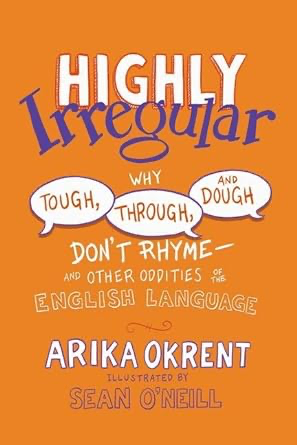
Probably you have at least some interest in language. Probably you are not a professional linguist. If both of these describe you (having an interest in language but not being a professional linguist), then Arika Okrent’s latest book, Highly Irregular, is for you.
So what’s up with the book’s odd title? Look at the subtitle, which gives a hint: Why Tough, Through, and Dough Don’t Rhyme―And Other Oddities of the English Language. But it’s only a hint. If you interpret it broadly enough, as you should, it tells you that Okrent is going to explain the historical reasons why language isn’t writing. Language is speech, not writing. Writing is merely a representation. In the case of English, what makes it such a poor representation? Well, that’s what Okrent explains, in small, easy-to-digest chapters, each containing a few concrete examples of one important idea. The abstractions are all there as well, but if you are the sort of reader who prefers the details, you can simply ignore the abstractions until they eventually sink in by osmosis. Trust me, they will.
Cartoons by Sean O’Neill enliven the prose and enhance the explanations. Don’t skip over them! Also, if you happen to be a prescriptivist by inclination or training, you will be gently enlightened without being hit over the head or preached to. The writing style is breezy and often humorous, never stuffily academic.
Although I’m not actually the intended audience for Okrent’s book, I thoroughly enjoyed it. I read it with two goals in mind: partly to see whether I would learn anything about English-language linguistics, but mostly to see whether I would get ideas of how to answer questions about English from students and other non-linguists. Okrent definitely let me accomplish both goals. There were plenty of chapters where I wished for greater depth, but greater depth would inevitably vitiate the positive attributes that I describe above. I do have to say that I kept an eye out for any errors I could find, but I was not successful in finding any (there are a few instances where we have differing opinions, but nothing that could definitively be called an error). Keep in mind that I studied linguistics back in the ’60s, so I too could be making errors, perhaps based on out-of-date scholarship in my case, but there too nothing popped up. I did gain one new (new to me, that is) perspective from reading Highly Irregular: a more coherent overview of the linguistic effects of the various invasions of Great Britain from 1066 onward, including the invention of the printing press on the other side of the Channel.
Categories: Books, Linguistics
 Learning Strategies