Why, you ask, would we need a better alphabet? Nothing is wrong, you say, with the one we have. We all learned it in kindergarten, after all.
I suppose some other alphabets are prettier, so that might entice you; and some avoid the few problems that two or three of us have with our use of the Latin (a.k.a. Roman) alphabet. But still…
Before discussing the pros and cons let’s look at a few of the many real alphabets currently in use (if your system is missing some fonts, these might not look right on your screen):
- Greek: Παντῶν χρημάτων μετρόν ἐστιν ἄνθρωπος
- Cyrillic: Где Карандаш?
- Armenian: Արցախի Հանրապետություն
- Devanagari: देवनागरी लिपि
- Thai: ทุกคนควรได้รับการปฏิบัติในทางเดียวกัน
- Arabic: وَكَانَ أَهْلُ الأَرْضِ جَمِيعاً يَتَكَلَّمُونَ أَوَّلاً بِلِسَانٍ وَاحِدٍ وَلُغَةٍ وَاحِدَةٍ.
- Hebrew: מזמן לא נפגשנו
- Korean: 모든인간은태어날때부터자유로우며
We could keep going, but let’s stop there. If you believe that our alphabet needs improving, we could perhaps pick one of these eight — but I can tell you right now that it wouldn’t work, no matter which one you picked.
To see why, let’s think about why many people have difficulty reading English, and what it would take to remove that difficulty. Any alphabet is supposed to provide a set of symbols that represent the sounds of a language, so the 26 letters of our alphabet should be able to represent the 44 phonemes of English. Right away we see a problem. This lack of one-to-one correspondence means that we will need (at least) 44 letters. But I am risking repeating what I wrote four years ago, which seems pointless; so please just go back and read (or re-read) that earlier post, and then I will append only one more paragraph.
So, have you read the earlier post? If not, please read it right now, before you proceed to the concluding paragraph.
OK, now for my one new comment on the difficulties of spelling reform. For years I’ve been listening to Will Shortz present his weekly NPR puzzle, and I always cringe whenever he picks a puzzle that relies on how a word “sounds.” Often he claims that two words sound alike, when they clearly don’t (merry and marry, perhaps?), and often he claims that two words sound differently when they clearly sound alike (pen and pin, perhaps?). Of course the truth is that there is no way to say whether Will is right or I’m right, as it’s merely a difference in dialects. (Actually, those of us from New Jersey have the correct pronunciation, whereas Will has an Indiana accent, perhaps tempered by his current residency in Westchester.)
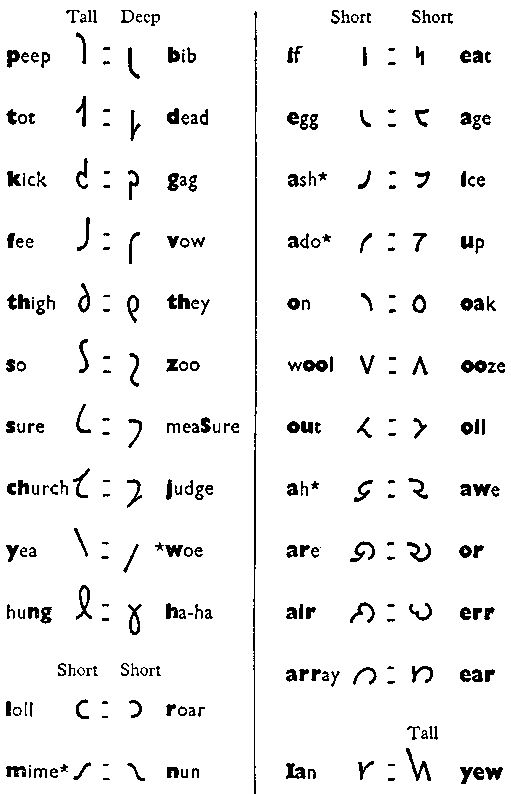
Would the Shaw alphabet work? Try it out, as I did.
Categories: Linguistics
 Learning Strategies