Louise Penny’s 19th Gamache novel, The Grey Wolf, is a gripping mystery that raises as many questions as it provides answers. Clearly that fact bugs a vocal minority of readers — see below — but it’s just fine with me, as questions are often more important than answers. Before I discuss that vocal minority, however, I will tell you a bit about the book. Just a bit.
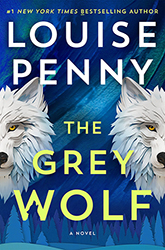
First of all, as usual we start in Three Pines, a (fictional) small village in the Eastern Townships in the province of Quebec. We also end the book in Three Pines, but it doesn’t play much of a role in between. (I phrase it that way because the locale is itself pretty much a character throughout the series, as you know if you have read some or all of the preceding novels. Speaking of which, I should add that you don’t need to have read them before reading The Grey Wolf, but of course it would help flesh out the villagers for you. Everything that’s absolutely necessary in the backstory is here for you, as long as you’re paying attention. In particular, the first chapter serves new readers by introducing them to Three Pines and its residents, and it brings readers of the prior books back into that world.)
I had to keep Google handy on my phone when reading the story, because I wanted to know what was fictional and what was real. Every time that I wasn’t sure, it turned out that Penny (or her assistants) had done their homework: in each of these cases the history and the geography turned out to be real. If that matters to you — as it does to me — rest assured on this score.
I could choose many different quotes, but I will limit myself to quoting a single paragraph:
Brother Christophe swung the heavy book containing the ancient recipe for Chartreuse and hit Sébastien squarely on the side of the head, knocking him senseless. As Chartreuse had done for centuries.
Penny’s style worked very well for me, though clearly not so well for everyone, especially her artful use of short paragraphs. If you’ve been reading this blog for awhile, you know that that style is one of my models. And you correctly expect that some politics must creep into the narrative — in this case at least some green issues (no, I don’t mean Chartreuse) and some very corrupt politicians. (Yes, let me remind you that we’re talking about Canada!) 🇨🇦
OK, enough about the book itself. I shouldn’t say more lest I accidentally fall into the trap of including a spoiler or two. Let me just say that I was totally absorbed by the story itself, by the characters, and by the issues that Gamache wrestles with. Now let’s turn to the topic that I raised in my first paragraph above: that minority of readers who dislike the book. How, you may ask, do I know that they are the minority?
It’s easy.
As I normally do, I avoided reading any reviews until after I’ve finished reading the book in question (except for that one review that persuades me to read it in the first place). And I almost always read the negative reviews first. So… let’s take a look at the numbers. As of this date, over 16,000 amateur reviewers have posted reviews (or at least ratings) on Amazon, with an average rating for The Grey Wolf of 4.5 out of 5 — is that the mean? median? who knows? but I can see that the mode is clearly 5 in this case. So I decided to read the few dozen reviews that gave the book a 1, since 0 is never an option. Now of course we know that de gustibus non est disputandum, as the Romans would say — or, if you prefer, chacun à son goût, as the French would say (probably the preferable choice in this case) — so I can’t argue with those who disliked the book, but here are my observations:
- A lot of these reviewers positively hated the book because they require quick and definite answers to everything. That’s often the reason that they read mysteries in the first place.
- They practice black-and-white thinking, which doesn’t allow them to wait until the sequel, when some of their questions won’t be answered even then.
- They don’t like change! How dare the author write a book that’s not exactly like all the previous ones?
- They go so far as to conjecture that this one must therefore have been ghost-written by somebody else!
- They don’t like science, where answers can change when the data change.
- They wish the author had written a different book altogether. So what? I choose to read and review what she wrote, not what I wish she had written.
Looked at the right way, these six observations all say more or less the same thing. Read the book yourself and see whether you agree with them or with me and the majority.
Categories: Books
 Learning Strategies