The title is a pun — but it makes sense only if you know what linguists mean by the word “accidence.” Despite that limitation, Accidence Will Happen is very much a book for the general educated reader, not for the professional linguist. Of course you can’t judge it by its cover (see image below), but I do need to comment briefly on the four instances of the English teacher’s red pen that the publisher decided on. I like the first three corrections, but I find it implausible that an author would mistype his own name. And since neither your nor I have heard of Oliver Kamm before, we wouldn’t know whether Kam or Kamm is the correct spelling. But this is probably an example of dry British humour, so don’t take it seriously.
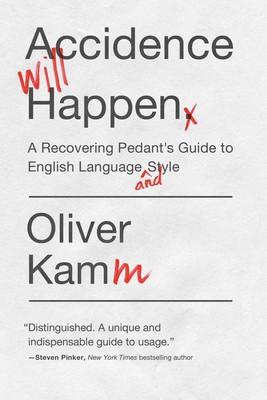
That leaves you with two questions, I suppose: what is accidence? and what is this book really about? The subtitle, A Recovering Pedant’s Guide to English Language and Style, gives you a pretty good clue to the latter, and we naturally turn to Dr. Google to get an answer to the former:
[accidence] a part of grammar that deals with inflections (see INFLECTION sense 2a).
Inflectional morphology studies the way in which words vary (or “in-flect”), in order to express grammatical contrasts in sentences, such as singular/plural or past/present tense. In older grammar books, this branch of the subject was referred to as “accidence.”
—David Crystal
Grammar has become that branch of linguistics that deals with a language’s inflexions (accidence), other structures of words (morphology), its phonetics system (phonology), and the arrangement of its words in sentences (syntax).
—Philip Howard
You will recall my recent review of a book that is similar but different (if you don’t mind my saying so): Says Who? The two books share a point of view but not a structure, so you may want to go back and re-read my review of Says Who? Then you can compare and contrast with what Kamm says about Accidence Will Happen:
This book has three main arguments. First, you are already a master of grammar. Trust me on this. You became one when, as a young child, you acquired a set of rules — whether of Standard English, or another variety of English, or another language. Second, there’s no cause for alarm about the state of the English language, which is in excellent health and can look after itself. Third, if you use English, it’s useful to know the conventions of Standard English.
Before commenting on Accidence Will Happen, I would like to point you to the illuminating Wikipedia piece on Oliver Kamm; it will tell you a good deal that is not part of this review. You may also want to know that Kamm’s point of view is very strongly descriptive (as opposite to prescriptive) and very strongly Chomskyan (as opposed to — well, there is no room here to name and describe the alternative possibilities).
When you find out that Kamm is a columnist for the London Times, you will probably be surprised at the preceding paragraph: somehow it seems antithetical to being anti-prescriptive. But there is no reason to be surprised, as he points out in many places in the book. He also isn’t afraid of naming names when it comes to praise and blame.
I vividly remember the big outrage in 1961 when people ranging from Nero Wolfe to my father were up in arms (not literally) at the Third Edition of Webster’s Unabridged Dictionary because it was unapologetically descriptive. Wolfe went so far as to burn it, page by page. (Yes, I know that Wolfe was fictional, but I suspect that his views were shared by Rex Stout, the author who created him). The original Webster explained that “grammars are made to show the student what a language is, not how it ought to be,” and that’s a major point of Accidence Will Happen.
I mentioned above that Accidence Will Happen and Says Who? share a point of view but not a structure. There is also a difference in tone: although both have a sense of humor, Accidence Will Happen is a little bit dryer and less amusing. Or perhaps I’m just not reading the British tone correctly. Also, the structural difference is that Says Who? is organized into a small number of chapters, each focused on a big idea, but only the first half of Accidence Will Happen is organized that way; the second half is strictly alphabetical with a very large number of short entries, each focused on a word or context. Both methods work. So go read both of these books!
Categories: Books, Linguistics
 Learning Strategies