Of course I knew that I had to read Polostan as soon as I saw that the author was Neal Stephenson. His 19 previously published novels are all IMHO first-rate — ranging from 1984’s The Big U to 2021’s Termination Shock — so I correctly assumed that Polostan would be as well. (Actually, it’s a bit unfair for me to generalize about those 19 novels, since I’ve read only 14 of them, but my conclusion is still probably correct about the other five.)
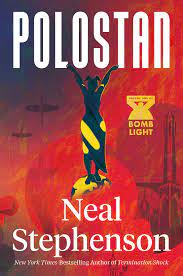
Wikipedia points out that “Stephenson’s work explores mathematics, cryptography, linguistics, philosophy, currency, and the history of science,” so it surprises no one who knows me that I am a Stephenson fan, as the paragraph above suggests. His books are most often categorized as science fiction, but they are so multidisciplinary that you can’t really place them in any single bin. Polostan, in particular, is more historical fiction than anything else. Now I have to tell you that I had completely misunderstood the title before starting to read the story. I thought at first that it was traditional alternative history. You know the sort of thing I mean: novels that ask what it would be like today if Germany had won the Second World War and so forth. In this case I figured that it would explore what it would be like if Poland had somehow become a major power and had spread into Central Asia, amidst all those other “stan” countries (you can probably name five or six of them off the top of your head). But now, although the “stan” conjecture turns out to be almost correct, the first half of the title word actually refers to the game of polo, not Poland! By polo we’re talking horses, not water, and you’ll just have to read the book to find out why.
The time period is the 1930s, so of course the Great Depression and the rise of the Nazis lurk in the background everywhere. And “everywhere” is part of the key, since the novel takes place in various locales in both the U.S. and the U.S.S.R. Communism is a big deal on both sides of the Atlantic. As I always do when reading historical fiction, I kept asking myself which actions, locations, and characters were real (i.e., historical) and which were made up (i.e., fiction). Clearly the protagonist — a young Russian-American woman — had to be fictional, as she indeed turned out to be, but I had to keep my phone open to Wikipedia to double-check everyone and everywhere else. Was the World’s Fair really as described? (Yes.) Were generals Patton and Eisenhower really as Stephenson portrays them? (Yes.) Was/is Magnitogorsk a real city in Russia built with a purpose as presented? (Yes.) Was Beria really as described? (Yes.) I’ll stop here, but every single event and person checked out to be scrupulously accurate except of course for the ones that were clearly made up out of whole cloth.
Stephenson always likes to indulge in long lists from time to time. Don’t skip them just because you think you can do so! In Polostan, when our protagonist, Dawn or Aurora (depending on whether she’s being an Anglophone or a Russophone — again you will have to read the novel to find out what that’s about) is learning how to assemble a rifle, my mind couldn’t help returning to English class one day in 1964 when we were reading Henry Reed’s poem The Naming of Parts. (How do I still remember that after 61 years? Well, that’s a subject for another post.) I’ll quote the first stanza, and you can read the rest (and the interpretation if you wish) on your own:
Today we have naming of parts. Yesterday,
We had daily cleaning. And tomorrow morning,
We shall have what to do after firing. But to-day,
Today we have naming of parts. Japonica
Glistens like coral in all of the neighbouring gardens,
And today we have naming of parts.
Categories: Books
 Learning Strategies