Poor Hank Green: if you ask a random person who Hank Green is, the likely answer is either “the brother of John Green” or “never heard of him.” I suppose sibling rivalry is inevitable when your brother sells 23,000,000 copies of The Fault in our Stars. But Hank wins in the end, since An Absolutely Remarkable Thing is (IMHO) a much better and much less sentimental novel than The Fault in our Stars. Even as a New York Times bestseller, An Absolutely Remarkable Thing (AART) is not going to sell 23,000,000 copies, but who cares about that?
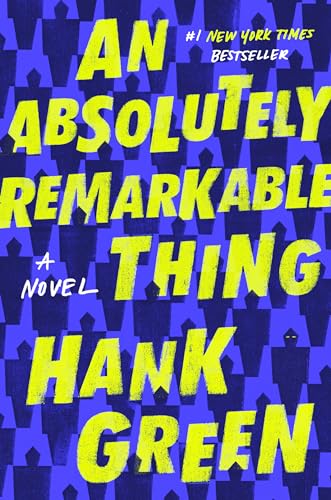
So, I hear you ask, what genre of novel is AART? Unlike his brother’s book, it’s not YA. I suppose it’s a combination of science fiction and political allegory — a bit like Animal Farm or perhaps 1984, although no one would suggest that AART is ever going to be considered a great work of literature. Without giving you any spoilers, I can tell you that the premise is that the world reacts in two different ways to a giant unmovable robot that suddenly appears on a street in Manhattan. Half of the world react with fear and xenophobia to this undocumented alien (in the science-fiction sense of alien but….), the other half are welcoming and optimistic. (See the third bullet item below.) I can’t say much more without giving away too many plot details, although I can safely tell you a few random points:
- The main narrative device is interior monologue. The reader learns a lot about the narrator, April May (sorry about that), by seeing what she’s thinking.
- An early view into April and her roommate tells us “A couple items of clothes on the floor, one too many cups on the desk, way too many books on the nightstands. I don’t really understand people who keep everything around them constantly neat.”
- To figure out Carl, the robot — or is he a robot? — group problem-solving is required. The right-wingers hate that and call April and her followers traitors to humanity. Carl presents many puzzles, starting with his origin and why he is there. It’s rather like the MIT puzzle hunt. There are two teams: the good guys, including April, and the bad guys, including right-wing podcasters and the like. Who will solve the puzzles first? Can Quora help?
- “I distilled a diverse group of individuals down to a few of their beliefs. Those beliefs were based on fear, and so all my arguments began and ended with the same thought: You’re all cowards. I didn’t say those exact words out loud, but they heard them anyway. The people who supported Carl and supported me heard it too, and they loved it. They wanted me to say it all the time. Reasoned, caring conversations that considered the complexity of other perspectives didn’t get views. Rants did. Outrage did. Simplicity did. So, simple, outraged rants is what I gave people.” [I sit here having just read Trump’s rant about Easter as I type this.]
- Knowing how the Mayan numeral system works will help you figure out a small piece of the mystery. If for some reason you don’t know Mayan numerals — and why don’t you??? — you’ll learn their relevance soon enough.
So what inspired all AART? My friend Brian inadvertently told me: in a totally different context, he mentioned a movie called The Iron Giant; so I went and read the Roger Ebert review of that movie, and I have no doubt that that’s what inspired AART.
Clearly a sequel is necessary, and indeed there is one: A Beautifully Foolish Endeavor. It’s on reserve for me at the library.
Categories: Books
 Learning Strategies