“I never use pronouns,” says one Susan Sparks Smith in a Facebook post. I don’t know her, but I was sorely tempted to reply “You just did.”
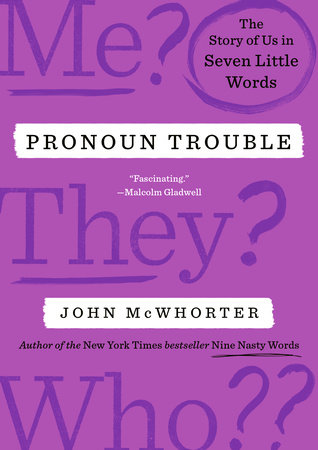
That’s just one example of Pronoun Trouble, the new popular linguistics book by Columbia professor and public linguist John McWhorter. Actually, it’s my example, not McWhorter’s, but it still represents one of the many ways that pronouns cause trouble in this fascinating and entertaining book. Some readers may wonder how McWhorter can manage to stick to this one narrow topic for two hundred pages; others may wonder how he can deal with this broad topic so thoroughly in a mere two hundred pages! If you’re in the former camp, you just don’t understand how surprisingly meaty this “narrow topic” is; if you’re in the latter camp, you’re probably a professor yourself.
So, what kinds of pronoun trouble can you think of off the top of your head? Surely gender issues come first to mind in today’s world, no matter which side you’re on. If you’re historically minded, perhaps the loss of thou and thee are what you think of. If you’re prescriptive or pedantic, you may think of singular they as a pronoun problem. And you may see red when you hear “Between you and I, Billy and me are the only ones who care.” McWhorter does deal with all these issues — combining historical research with a great sense of humor. As a popular linguist (he prefers “public-facing linguist”), he makes informed guesses whenever his historical research is merely suggestive rather than definitive, but he’s always straightforward about it in those cases.
As a pop linguistics book, there’s nothing so technical here as to scare off someone with no background in linguistics — no mentions of ablative absolutes or alveolar fricatives, no use of the international phonetic alphabet. So I’m clearly not the intended audience, but I didn’t just read Pronoun Trouble for fun or as a refresher. It was both, but also I learned some new things. For instance, although I knew that singular they is not a recent phenomenon (no matter what prescriptivists may think), I had never thought about the fact that there are actually two very different kinds of singular they, as exemplified by these sentences that McWhorter provides:
- Every employee will think they can just go in there and grab a snack.
- Where’s Tyler? They just left.
Your assignment is to explain why some people (perhaps you?) find the first sentence acceptable but not the second. After you think about it, read the book. You’ll enjoy it, and you’ll learn something.
Categories: Books, Linguistics
 Learning Strategies