As you can see in the image below, Gobsmacked! is the title of the latest book by Ben Yagoda. The subtitle, The British Invasion of American English, provides (as usual) much more information than the title itself. Of course those of us who were around in the ’60s immediately think of a different British Invasion, and I don’t think that’s a coincidence.
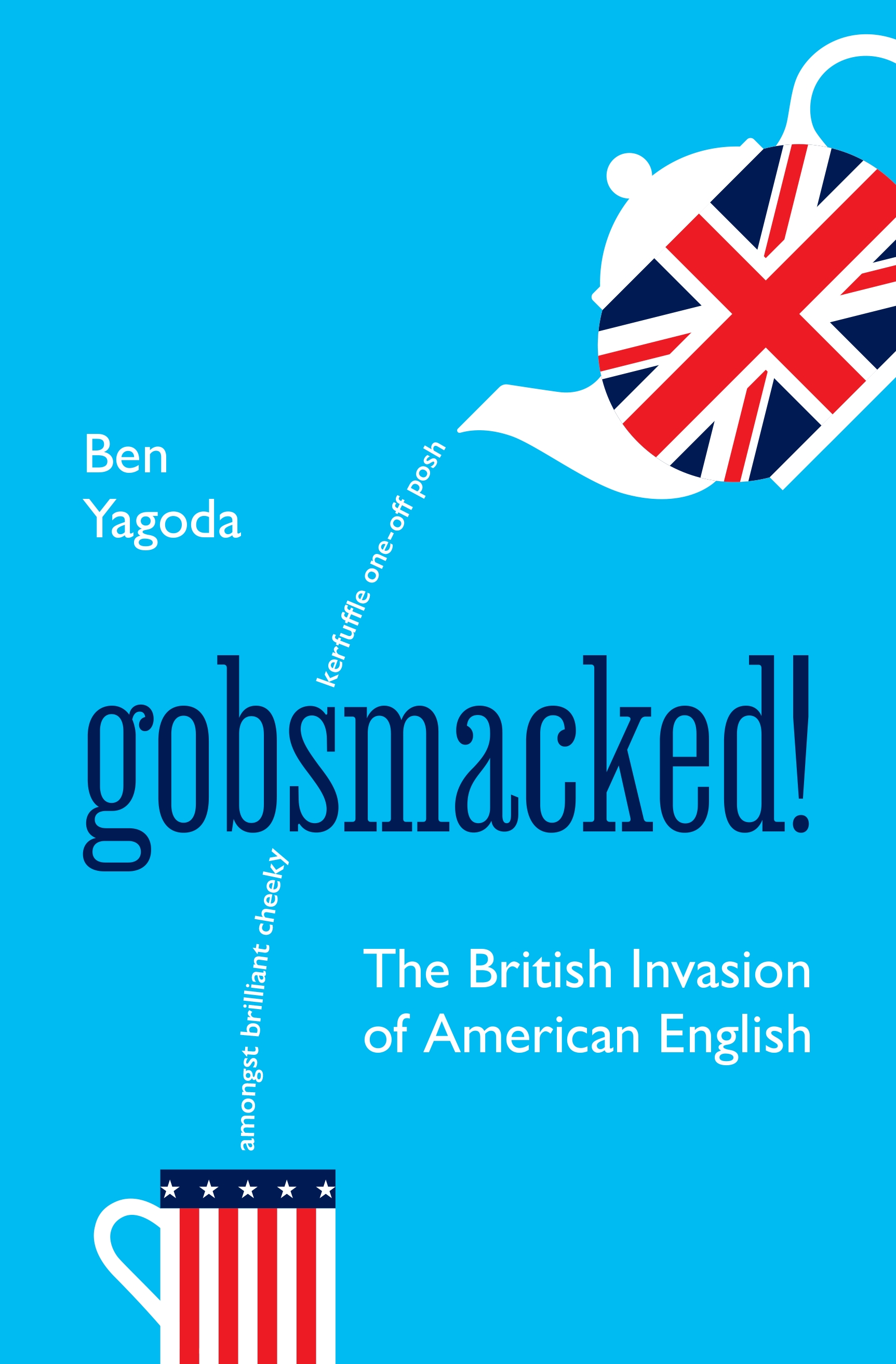
This is not really a linguistics book, although it subject is definitely linguistic in nature. Yagoda is a journalist by trade, not a linguist (which is either a point in his favor or a point against him, depending on your point of view). “I don’t even play one on TV,” he explains.
Surprisingly, under those circumstances, I wasn’t struck by any glaring linguistic errors. Almost everything is evidence-based, with a few clearly labeled conjectures where evidence is unavailable. Yagoda even supplements his findings with appropriate Google ngrams.
The overall theme of the book is what Yagoda calls NOOBs, a confusing form to those of us internet old-timers who know noobs or newbs as a short form of newbies; perhaps the confusion is intentional. In this case it stands for Not One-Off Britishisms, which Yagoda defines as “British words and expressions that have got popular in the U.S.” (Note the “have got” rather than “have gotten.”) As for the “one-off,” I guess the point is that these borrowings aren’t just hapax legomena, but have begun to take off (or have already taken off) as part of the American idiom.
OK, OK, if for some reason you have neglected to study ancient Greek, feel free to google hapax legomena.
Anyway, Gobsmacked! is based on Yagoda’s blog, Not One-Off Britishisms, a fact that is responsible for both the book’s strength and its weakness. Its strength is that there are tons of well-supported examples and clear explanations; its weakness is that it often feels like a random collection of related blog posts rather than a unified treatment with a coherent thesis. If you adjust your mindset accordingly, you can almost pretend that it’s the latter. Basically, because the blog provides a continual dry-run, the book is essentially a second edition right out the door.
Categories: Books, Linguistics
 Learning Strategies