“When a language disappears, a unique way of understanding the world vanishes with it.” If I had to pick a single sentence from Lorna Gibb’s Rare Tongues, that sentence (164 pages into the text) might be my choice. But the book is about a lot more than endangered languages.
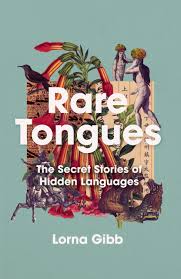
As you notice in the image of the book cover (below), the subtitle is The Secret Stories of Hidden Languages. But of course you can’t judge the book by its cover! Are these really “secret stories”? Are the languages discussed really “hidden”? Well, I’ll let you in on a secret: the answer to both questions is no. Clearly the subtitle was added by some marketeer at the publisher’s who thought it would help sell books. Clickbait we might even call it, if it were online. So let me tell you the truth.
This book consists of interesting stories about many languages: Latin, Khoikhoi, Manchu, Penan, Ainu, Aramaic, Hawaiian, Nuxálk, Sámi, whistled languages, Sicilian, Corsican, Catalan, Monégasque, Basque, Tamil, Tajik, Hebrew, Māori, Guarani, and Scottish Gaelic! So how could I resist? The answer, of course, is that I couldn’t. Could Gibb really be an expert on all of these? Well… no, of course not. But she doesn’t pretend to be. She is, however, a professional linguist, and she includes a surprisingly thorough and accurate appendix describing all the technical material mentioned in the book, including the various branches of linguistics. So refer to that if you need to! The intro also includes some useful general information; in fact it could well be a standalone article all by itself.
The author provides lots of historical and sociological information about each language wherever that’s relevant. Since most of it naturally has to be second-hand, it’s no wonder that Gibbs’s first-hand lived experience with Scots and Scottish Gaelic does an especially effective job of bringing those two languages to life.
Although I enjoyed reading Rare Tongues, I do have a (small) number of complaints:
- In her discussion of Classical Latin and Vulgar Latin, Gibbs says that “the second-person pronoun ‘tu’, now familiar to use from modern-say French [and Spanish!], replaced the Classical Latin ‘vos’ as the singular pronoun for ‘you’.” But I think this must be an error, for as far as I know ‘vos’ was never a singular pronoun. I could be wrong.
- On the whole, the point of view is altogether too Whorfian for my taste. This feels really outdated for a 2025 book, even though it’s always interesting. Interesting, but tendentious.
- Gibbs transliterates Hebrew ‘רוחשša’ as ’saxor’; I’m sure you can find all four errors there, not the least of which is that two of the letters aren’t even Hebrew!
- The following paragraph just doesn’t make sense to me:
Thus, if we take the root ‘QRB’ (to come) and add the prefix ‘Qa-’ and the suffix ‘-ib’, ‘QRB’ (to come) becomes ‘Qarib’ (he/she/it comes).
It goes on in the same vein, but I just don’t see how that works. Maybe I’m missing something.
Categories: Books, Linguistics
 Learning Strategies