What do you know about Cornwall? Cornish hens, I suppose. And Cornish pasties, but only if you’ve been to Britain. That’s probably it, unless you have an esoteric linguistic interest in the lesser-known Celtic languages, as I do for some reason. You’re probably aware of the three best-known Celtic languages — Irish Gaelic (more properly just called Irish), Welsh, and Scots Gaelic (sometimes called Scottish Gaelic or just simplified to Gaelic, but never simplified to Scots, which is an entirely different language) — but Manx (the language, not the tailless cat), Cornish, and Breton escape the notice of most non-linguists.
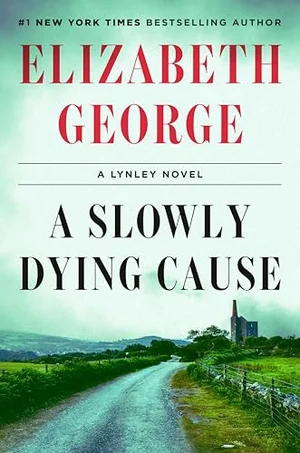
And what, I hear you ask, does all this have to do with Elizabeth George, an American author who writes British mysteries with a truly English atmosphere? Just that Cornwall itself is functionally a character in A Slowly Dying Cause, as is (occasionally) the Cornish language. That is no surprise to readers of the Lynley series, especially the last few novels, but it might be jarring to newcomers. If you’re a newcomer here, you shouldn’t start with this atypical book, as my friend Brian points out; he observes that Lynley does appear as a character in this “Lynley novel,” but “not in any way connected to the murder investigation until quite late in the book.” He opines that…
…this must be a new trend; there’s a new(ish) John Irving that’s said to be in the world of The Cider House Rules, and similarly Wilbur Larch appears as a character in it (according to the Guardian; I haven’t read it yet) but only barely. And a related but not identical instance is the prequel to To Kill a Mockingbird.
Another way in which the book is kinda trendy is that it alternates third-person narration of the investigation with first-person reportage by the murder victim-to-be. The latter is rather an unpleasant character, so I found myself rooting for whoever the murderer turned out to be. Apart from that, though, it’s a pleasant enough read. But anyway, if you’re an Elizabeth George fan you’re going to read it no matter what I say, and if not, this isn’t the book you should start with.
What I haven’t found anyone discussing is the import of the title. The “slowly dying cause” is the tin-mining industry in Cornwall (actually tin-streaming, as I learned from the book). The economy in the region is a lot like the American post-industrial midwest and the southern tier of New York, and you have to have patience to work through those observations and other material in the novel’s 656 pages — I loved what I learned and always felt totally immersed in this unfamiliar world, but YMMV. In addition to Lynley there are four other characters who are making return appearances from earlier novels, but George provides plenty of background info so you won’t feel lost. If, however, you’ve only met them through television, you will notice many discrepancies — but TV isn’t canon, so you can ignore those discrepancies.
You may also be sidetracked by the ongoing relationship between an older man and a much younger woman, at least if you’ve been paying attention to contemporary events. Is that a coincidence? Who knows? A reviewer whose nom de plume is Roman Clodia says it isn’t:
[T]he theme of the book [is] how toxic men abuse and victimise women: we have Geoffrey and his teenage ex-pupil lover, Michael who breaks up his marriage and family over an 18 year old cruise ship dancer, Jesse’s cheating boyfriend, Sebastian’s Lothario games, Dairdre’s abuse, even Lynley goes on a guilt trip at the end. This series has always been character-driven and it’s one of George’s strengths that she creates complex situations and characters — here, though, most of this is essentially filler and stand-in for the murder investigation which barely gets off the ground.
In conclusion, I enjoyed the book a lot and devoted an inordinate amount of time to it (I don’t read as quickly as I used to, but at least I have plenty of time in my retirement). Just don’t read this as a whodunit, and do soak in the world of Cornwall. If I were still traveling, I would want to visit.
Categories: Books
 Learning Strategies