This book would have made an excellent New Yorker article. But a whole book? Not so much. All right, I suppose many a New Yorker article does feel like an entire book — but Enough is Enuf by Gabe Henry really is an entire book and shouldn’t be, even though there’s plenty to admire about it.
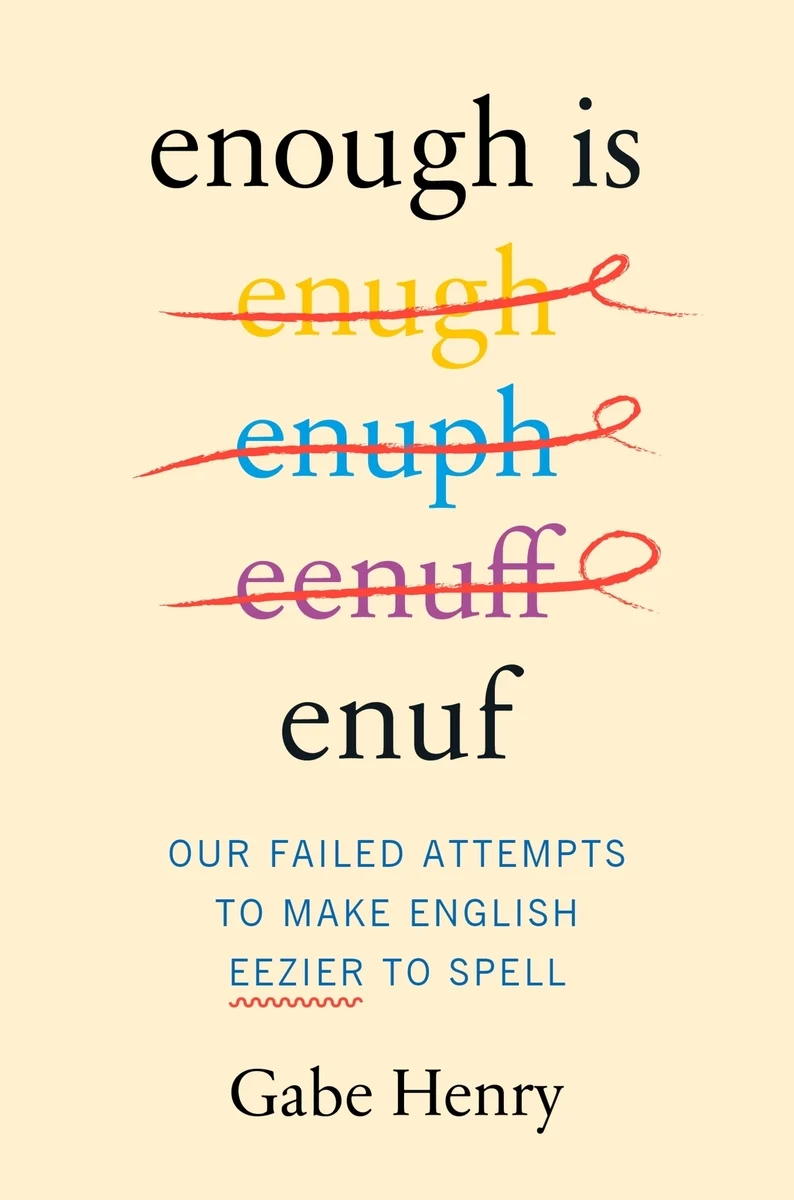
We all know that English spelling is a mess. Some of us even know why. Enough is Enuf tells us more than we wanted to know about (as the subtitle says) “our failed attempts to make English easier to spell” — I mean “eezier to spell.” Amazon says that it is “brief and humorous.” Humorous, yes. Brief, no — unless you consider 304 pages brief. Even New Yorker articles aren’t that long.
The problem isn’t just length, it’s also that almost every chapter is alike. There’s basically no arc. The book does tell a story, but almost every chapter tells the same story. I would like to know whether all the spelling simplifiers in the book were on the spectrum, but there’s no hint of whether that would account for the similarities. The subtitle makes it clear that almost all of the attempts failed, but I was looking for more discussion of why: for instance, a phonetic spelling would follow someone’s pronunciation, but whose? And if we used simplified spelling, how would we read books that were published earlier (in “conventional” spelling)?
Finally, there are a few errors in the book. The most egregious — albeit a common one — is that the author apparently believes that the word emoji is parsed as emo-ji, but in fact it’s actually e-moji and has nothing to do with emoticons.
Henry succeeds in a couple of ways. One is that he is really thorough about his topic, including not only the many attempts to improve English spelling using our standard alphabet. He delves into the relevant history, describes the relevant personalities, and gives the pros and cons of each attempt. The other success is that he goes beyond our usual Roman alphabet (often with diacritics) and includes shorthand, the Shavian alphabet, etc. But enuf is enuf!
Categories: Books, Linguistics
 Learning Strategies