Odds are that you studied a European language back in high school — most likely Spanish or French, possibly German or Italian — and you quickly realized that the vowels in those languages are not pronounced as they are in English. Our so-called long vowels are a mess: the vowel sound in mate is definitely not just an elongated version of the vowel in mat, nor is the vowel in bite a longer form of the vowel in bit. In other European languages a long “i” is closer to the English long “e” (though without the y glide at the end), and a long “e” is closer to the English long “a” (ditto). So what’s going on here? Things used to be much more sensible half a millennium ago! How did they change?
Well, as you may know, the culprit is a process known as the Great Vowel Shift:
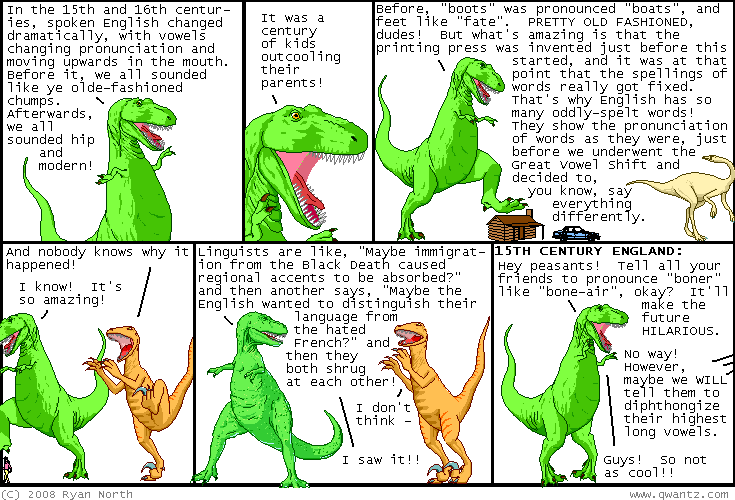
After reading that cartoon, you may want a clearer explanation. Let me know what you think.
Categories: Linguistics
 Learning Strategies